

Table of Contents
- Why Viral Gadgets Are So Hard to Evaluate
- How to Spot Fake Reviews on Amazon Before You Buy
- Are Cheap Electronics Safe to Use at Home
- Viral Gadgets Tested: What Actually Delivers Value
- Counterfeit Detection: Spotting Fakes Before They Arrive
- Consumer Rights Act 2015 Returns: What You're Entitled To
- Environmental Impact and E-Waste: The Hidden Cost of Impulse Buys
- How to Make a Smarter Purchase Decision on Trending Tech
Last Updated: August 13, 2026
Why Viral Gadgets Are So Hard to Evaluate
Viral gadgets look extraordinary in a 15-second clip but often arrive underwhelming in person. Social media compresses the purchase decision into an emotional moment, hiding real-world limitations. A gadget that looks effortless on camera may require fifteen minutes of setup every time you use it.
At Funky or Wot, we've developed a clear framework for separating genuine utility from clever marketing. The difficulty comes down to three factors: video format hides real-world friction, review ecosystems are heavily gamed, and most viral product storefronts have no meaningful return policy.
How to Spot Fake Reviews on Amazon Before You Buy
Fake reviews are the single biggest obstacle to making a confident purchase decision. Understanding how to identify manipulated review sections takes about five minutes of practice and can save you from significant post-purchase regret.
Red Flags in Review Sections
The most reliable red flags cluster around timing and language. A product that receives 200 five-star reviews within its first two weeks is almost certainly running an incentivised review campaign. Suspicious patterns include:
- All reviews posted within a narrow date window
- Identical or near-identical phrasing across multiple reviews
- Reviewer profiles with no purchase history outside this one product
- Reviews that describe the product in marketing language rather than personal experience
- Five-star reviews that mention receiving a "discount" or "free product" in exchange for feedback
Tools like Fakespot and ReviewMeta analyse review authenticity algorithmically, and the Which? guide to spotting fake reviews offers practical advice grounded in UK consumer research.
What Verified Purchase Patterns Tell You
Verified purchase badges matter, but they're not a guarantee of authenticity. A product with genuine long-term value accumulates a natural distribution of ratings, with a cluster of four-star reviews and meaningful numbers of three-star and below. A product with 94% five-star ratings is almost certainly manipulated.
Filter specifically for one-star and two-star verified reviews. These are the hardest to fake and the most informative. If multiple low-rated reviews mention the same specific failure, treat that as a reliable signal.
Are Cheap Electronics Safe to Use at Home
Cheap electronics can be genuinely dangerous. Unbranded chargers, poorly made LED strips, and counterfeit smart plugs have been linked to electrical fires and device damage. Safety is not purely about performance; it's about physical safety.
UK Safety Marks and What They Mean
The UK Conformity Assessed mark, known as UKCA, is the primary product safety mark for goods sold in Great Britain. It replaced the EU CE mark following the end of the transition period. A product carrying a legitimate UKCA mark has been assessed against the relevant UK safety standards. The Office for Product Safety and Standards guidance on UKCA marking sets out exactly which categories require it.
Beyond the UKCA mark, look for:
- BS EN certification for electrical products, indicating compliance with British Standards
- IP ratings on anything marketed as water-resistant (IP67 means the device can be submerged to one metre for 30 minutes)
- RoHS compliance confirming the product is free from restricted hazardous substances
If a product has no visible safety certification and is priced dramatically below comparable branded alternatives, the safety case for buying it is weak. This is especially true for anything that connects to mains power.
Viral Gadgets Tested: What Actually Delivers Value
Not every viral gadget is a gimmick. Some products earn their social media attention because they genuinely solve a problem that mainstream products handle badly.
Hydration and Everyday Carry
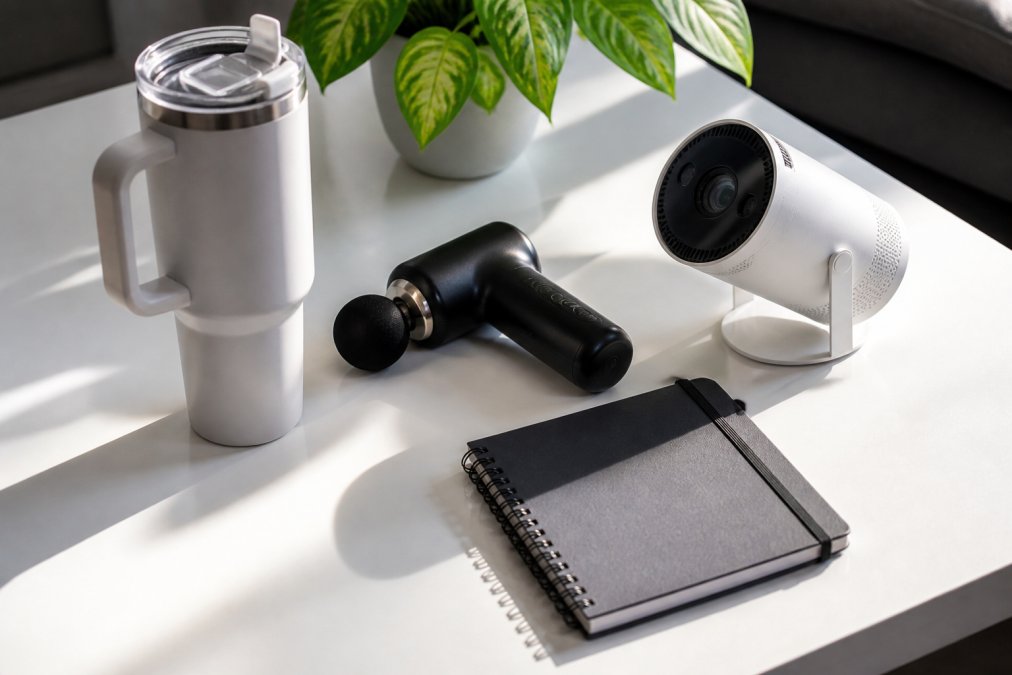
The Owala FreeSip Water Bottle (£23.99) earns its place through genuine ergonomic design. The dual-drinking spout (sip through the straw or swig from the wide mouth) is a practical solution for people who switch between activities. The double-wall vacuum insulation keeps drinks cold reliably, and the BPA-free materials address a legitimate concern for daily-use drinkware. The one caveat: the spout requires thorough cleaning to prevent mould.
The Stanley Quencher H2.0 FlowState Tumbler (£33.29) suits people who want to get through most of a day without refilling. Its 1.18L capacity and three-position lid are genuinely versatile. It's built from 90% recycled stainless steel, which adds an environmental dimension that matters to many buyers.
| Product | Starting Price | Best For | Key Limitation |
|---|---|---|---|
| Owala FreeSip | £23.99 | Active daily use, gym, commute | Requires careful cleaning |
| Stanley Quencher H2.0 | £33.29 | All-day hydration, desk use | Bulky for bags |
| Rocketbook Core | £14.89 | Note-takers, students, professionals | Needs specific Frixion pens |
| Theragun Mini | £169.00 | Post-workout muscle recovery | Battery life under heavy use |
| Dyson Airwrap | £369.00 | Versatile hair styling, heat-sensitive hair | Learning curve on attachments |
| ZIIP Halo | £379.99 | At-home skin toning, anti-ageing | Requires ongoing conductive gel |
| Our Place Always Pan 2.0 | £125.00 | Kitchen decluttering, non-toxic cooking | Hand wash only |
| Anker Nebula Capsule 3 | £359.00 | Portable cinema, outdoor use | Lower brightness than fixed projectors |
| Apple AirTag | £22.99 | Locating keys, bags, luggage | Apple ecosystem only |
Beauty and Wellness Tools
The Dyson Airwrap Multi-Styler (£369.00) divides opinion between "life-changing" and "overpriced". The Coanda effect technology, which wraps hair around the barrel using airflow rather than direct heat, is real engineering. Intelligent heat control that measures airflow temperature continuously addresses a genuine problem for people with fine or heat-damaged hair.
The ZIIP Halo (£379.99) sits at the premium end of at-home beauty tech. Microcurrent and nanocurrent facial devices have growing practitioner support, and the app-guided routines make the technology accessible without professional training. The device only delivers visible results with regular use, and ongoing conductive gel adds to total cost of ownership.
The Theragun Mini (£169.00) is the clearest value proposition in the wellness category. Percussive therapy devices have moved from physiotherapy clinics into mainstream use, and the Mini's portability makes it genuinely practical. Three calibrated speed settings and QuietForce technology mean it works in an office or hotel room without drawing attention.
Smart Home and Productivity
The Rocketbook Core (£14.89) is the most cost-effective genuinely useful product in this list. The notebook with erasable pages that scans to cloud services via an app works exactly as described. For students and professionals who prefer handwriting but need digital organisation, it solves a real problem at a low price.
The Anker Nebula Capsule 3 (£359.00) delivers a legitimate portable cinema experience. Native 1080p resolution with 4K input support, built-in Google TV with Netflix, and Dolby Digital audio in a soda-can form factor is technically impressive. This is a device for controlled-light environments, not outdoor daylight use.
The Apple AirTag (£22.99) earns its viral status through pure utility. Precision Finding with Ultra Wideband technology works accurately on supported iPhones, and the Find My network coverage is extensive. The hard constraint is ecosystem lock-in: without an iPhone or iPad, the AirTag is non-functional.
The Our Place Always Pan 2.0 (£125.00) addresses a specific kitchen problem: too many single-purpose pans. Ten cooking functions in one pan, a PFAS-free ceramic non-stick coating, and compatibility with all stovetop types make it a genuine space-saving solution for compact kitchens.
Counterfeit Detection: Spotting Fakes Before They Arrive
Counterfeits circulate on third-party marketplaces and social media storefronts, often at prices that signal a problem. The most reliable counterfeit detection method is price. Genuine premium gadgets have established retail prices, and any listing significantly below that range is either a grey-market import, used item sold as new, or a fake.
Beyond price, check these indicators before purchasing:
- Seller history: Buy from official brand stores or established authorised retailers, not third-party sellers with minimal feedback
- Packaging photography: Counterfeit listings often use stock images; request photos of the actual item and packaging
- Serial numbers: Many premium gadgets carry serial numbers that can be verified on the manufacturer's website
- Return address: Counterfeits frequently ship from addresses inconsistent with the brand's distribution network
- Grammar and spelling on packaging: Legitimate products have professionally produced packaging; fakes frequently contain errors
The Trading Standards guidance on counterfeit goods outlines your rights if you receive a counterfeit item.
Consumer Rights Act 2015 Returns: What You're Entitled To
Under the Consumer Rights Act 2015, goods sold to consumers in the UK must be of satisfactory quality, fit for purpose, and as described. If a product fails any of these tests, you have clear statutory rights.
Within 30 days of purchase, you have the right to a full refund if the product is faulty. Between 30 days and six months, the seller has one opportunity to repair or replace the item; if they cannot do so, you're entitled to a refund. Beyond six months, you may need to demonstrate that the fault existed at the time of purchase, but the protection still applies for up to six years.
A retailer's own returns policy can be more generous than the law requires, but it cannot be less generous. If a seller claims their "no returns" policy overrides your legal rights, that claim is wrong. The Citizens Advice guide to returning faulty goods explains the process clearly.
For viral gadgets bought through social media storefronts or unfamiliar overseas sellers, enforcement is harder. This is one of the strongest practical arguments for buying from established UK retailers.
Environmental Impact and E-Waste: The Hidden Cost of Impulse Buys
Viral gadgets and e-waste are more connected than most buyers realise. Consumer electronics are among the fastest-growing waste streams globally, and the UK Government's Waste Electrical and Electronic Equipment regulations require retailers to provide free take-back options for electrical items.
The environmental case for buying fewer, better products is straightforward. A Stanley Quencher built from 90% recycled stainless steel and designed to last years has a meaningfully different footprint than a cheap unbranded tumbler bought three times because the first two broke.
Before any gadget purchase, ask two questions: does this product have a realistic lifespan of more than two years, and does the manufacturer offer any take-back or recycling programme? Products that score well on both counts are worth paying more for.
How to Make a Smarter Purchase Decision on Trending Tech
The most reliable framework for evaluating viral gadgets is the "daily friction test." Before buying, describe in one sentence the specific problem this product solves. Then estimate how many times per week you'd actually use it. If the answer is fewer than three times, the product probably doesn't earn its place in your home.
Apply these filters before confirming any purchase:
- Check for safety certification: UKCA or BS EN marks for anything electrical
- Read one-star reviews first: They're the hardest to fake and the most informative
- Verify the seller: Buy from official brand stores or authorised UK retailers where your Consumer Rights Act protections are easy to exercise
- Calculate total cost of ownership: Some products require ongoing consumables that add significantly to the headline price
- Check the return policy before buying: Not after
The products that consistently justify their price are the ones solving a specific, recurring problem with genuine technical differentiation. The Owala FreeSip's dual-drinking spout, the Theragun Mini's portability, and the Rocketbook Core's cloud integration are real engineering decisions that improve on what came before. The gadgets that disappoint are the ones where the entire value proposition exists in the demo video and evaporates in daily use.
Funky or Wot's approach to curation is built around exactly this distinction. Every product is evaluated for real-world utility, not just visual appeal, which means the selection skews towards items that genuinely simplify daily routines rather than adding to the drawer of forgotten purchases.
Buying viral gadgets confidently comes down to asking harder questions before you spend. The Consumer Rights Act 2015 protects you once you've bought, but the smarter move is choosing products with verified safety marks, transparent sellers, and genuine long-term value. Funky or Wot curates its collection with all of these criteria in mind, selecting trend-driven products that are practical, quality-checked, and backed by real utility. Browse the Funky or Wot collection and find gadgets that actually earn their place in your daily routine.
Frequently Asked Questions
How can you tell if a viral gadget is a scam or legitimate?
Check whether the seller offers a traceable return address, a genuine customer service channel, and a clear warranty. Look for UK safety marks such as UKCA on electrical items. Search the product name alongside words like 'review' and 'does it work' to find independent opinions. If the only positive coverage comes from paid influencer posts and the listing has hundreds of five-star reviews posted within days of each other, treat that as a strong warning sign before committing to a purchase.
Do viral gadgets often violate consumer rights?
Not always, but the risk is higher with unvetted online storefronts. Under the Consumer Rights Act 2015, goods sold in the UK must be of satisfactory quality, fit for purpose, and as described. If a viral gadget fails those tests, you are entitled to a repair, replacement, or refund. The problem arises when sellers operate from outside the UK with no registered UK presence, making enforcement difficult. Buying from a curated retailer with a clear returns policy gives you far stronger practical protection.
Are viral Amazon gadgets usually good quality?
Quality varies enormously. Some products genuinely earn their popularity through solid build quality and useful functionality, the Owala FreeSip and Rocketbook Core are good examples. Others are low-cost copies of established designs, sold under unfamiliar brand names with inflated review scores. The safest approach is to cross-reference the product against independent review sites, check the seller's returns policy, and verify that electrical items carry the UKCA mark before buying.
What should you check before purchasing a trending tech product?
Confirm the technical specifications match your actual needs rather than the marketing headline. For smart gadgets, check whether the companion app requires ongoing subscription fees and whether it is compatible with your existing devices. For electrical products, look for the UKCA safety mark. Read one-star reviews as carefully as five-star ones, they often reveal durability issues that only appear after a few weeks of use. Finally, confirm the seller's return window and whether return postage costs fall on you or them.
This article was written using GrandRanker